New Construction vs Historic Charm The Albemarle Dilemma
Energy efficiency or architectural soul?
I’m Toby Beavers.
I’ve been helping buyers and sellers around Charlottesville and Albemarle County since 2003, and if there’s one debate that never gets old, it’s this: do you want the predictability of a new build or the personality of an older home with real history in its bones?
In practical terms, this usually shows up as a decision between newer neighborhoods out in Western Albemarle (think Crozet) and the older, storied streets closer to the city core, including areas near the historic Charlottesville Downtown Mall and UVA.
And yes, the choice really can feel like a trade: energy efficiency versus architectural soul.

Source: Zillow
The New Build Case: Modern living in Old Trail Village
When clients ask me why new construction has such a strong pull right now, I usually start with one word: performance.
A well-built new home tends to run tighter, quieter, and more consistently comfortable than most older housing stock.
ENERGY STAR certified new homes, for example, are positioned as at least 10% more energy efficient than new homes built to minimum code, and ENERGY STAR also cites studies showing sale price premiums up to 8% for certified and similarly efficient homes.
That combination of comfort plus long-term math is persuasive. ENERGY STAR
Energy efficiency you feel month to month
In communities where builders are marketing efficiency and better building envelopes, buyers often notice fewer drafts, fewer hot spots upstairs, and lower utility surprises.
ENERGY STAR specifically calls out quality-installed insulation, high-performance windows, and a comprehensive approach to sealing cracks and holes, which also helps keep out pollen, dust, pests, and moisture-driven problems. ENERGY STAR
Floor plans built for today’s life
Open kitchens that actually function, mudrooms that catch the clutter, flex spaces for working from home, and bedroom layouts that make sense.
In Old Trail’s planning, you also see a mix of housing types and a village-style concept that tries to blend residential with community amenities and a village center.
The Old Trail site describes a mix of single-family and multi-family housing alongside restaurants, businesses, and recreational facilities, all positioned as part of a broader lifestyle near the Blue Ridge. Old Trail Club
Builder warranties and “known” systems
New Old Trail townhomes typically come with builder warranties, and for many buyers, that is less about perfection and more about predictability.
In the early years, you are less likely to face the big-ticket unknowns that pop up in older homes.
And if you like details, some builder pages are very explicit about baseline materials and features.
Craig Builders’ Old Trail Village page lists items such as 2×6 exterior wall construction with R-19 insulation, hardwood in several main-level areas, tile in baths and laundry, and standard finishes like granite counters and stainless-steel appliances.
Whether those specifics fit your taste is subjective, but the bigger point is clarity: you can usually see what you are getting, in writing. Craig Builders
Video tour idea (Old Trail): Here’s a short neighborhood video that gives a feel for Old Trail in Crozet. YouTube
The Historic Case: Charm near Charlottesville Downtown Mall Historic District and Rugby Road-University Corner Historic District
Now let’s talk about the homes that make people stop mid-showing and say, “They just don’t build them like this anymore.”
High ceilings and architectural presence
Historic Charlottesville homes, especially those built in the late 1800s through early 1900s, often deliver ceiling height, plaster walls, thicker trim profiles, and a sense of proportion that feels different from modern construction.
Even when a historic home has been updated, you still feel the original intent.
Mature landscaping and real shade
This is one of the most underrated quality-of-life perks.
Mature trees and established gardens can change how a neighborhood feels in July.
New neighborhoods can be beautiful, but landscaping takes time to become the kind of canopy you get in older parts of town.
Proximity to living history
“North Downtown homes for sale history” is not just an idea; it’s the everyday geography of Charlottesville.
The Charlottesville Downtown Mall Historic District spans eight city blocks and is a pedestrianized segment of Main Street recognized for its post-WWII planning history and its design by Lawrence Halprin, completed in phases between 1976 and 1980.
In plain English, it is a big part of how Charlottesville real estate learned to be a modern, walkable city. Virginia Department of Historic Resources
A little farther out, the Rugby Road-University Corner Historic District covers about twenty blocks north of UVA and includes academic, commercial, and residential buildings tied to the university’s growth, particularly from 1890 to 1930.
If you love leafy streets and historic context, that district description reads like a buyer’s wish list. Virginia Department of Historic Resources
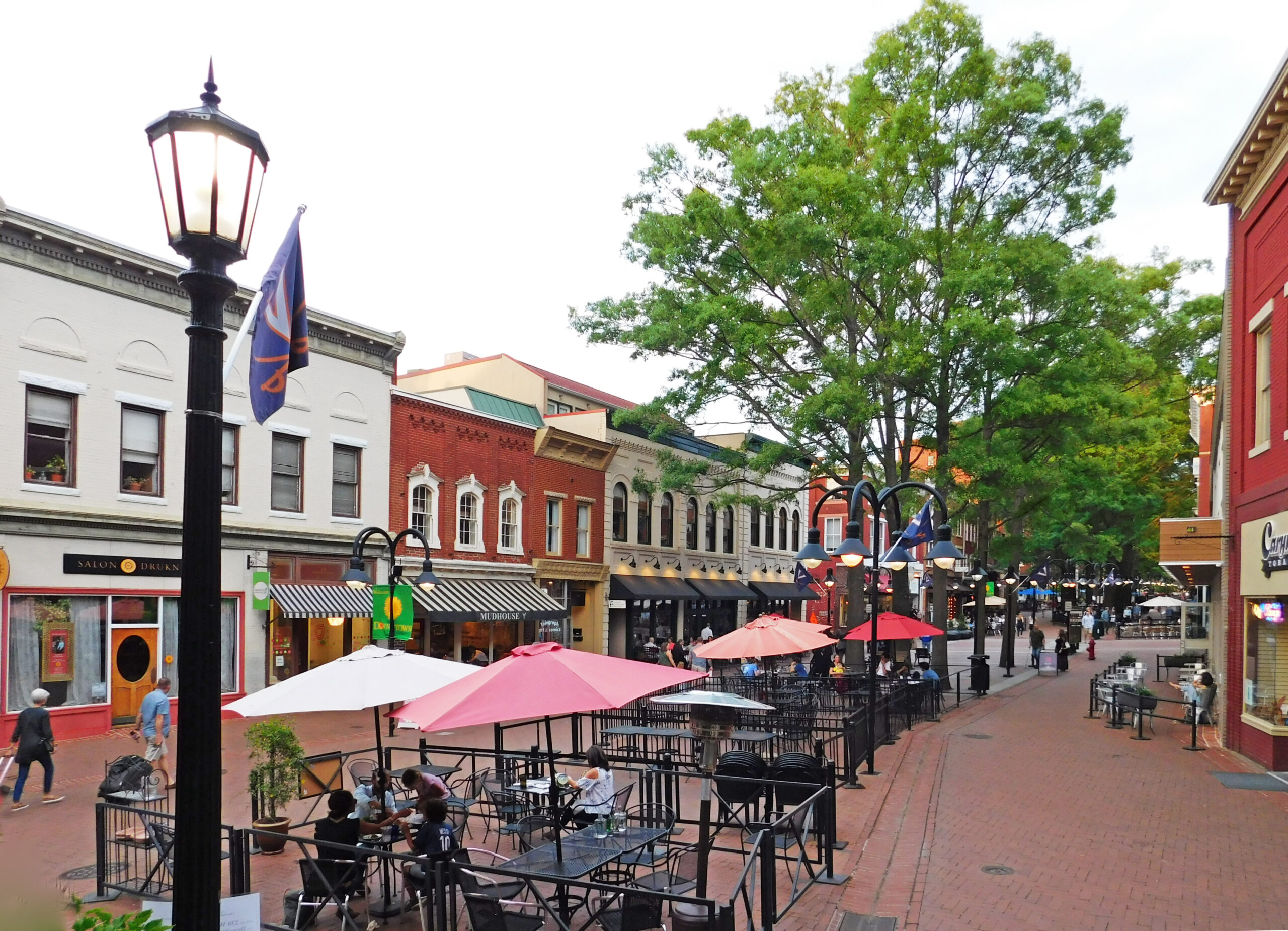
Source: Virginia Department of Historic Resources
Walking tour idea (Downtown): Want the vibe before you book showings? A long-form walk-through helps. YouTube
Maintenance Realities: The honest cost of a 100-year-old home in Virginia’s humid summers
Here’s where I get very candid with clients: if you buy a Charlottesville historic home, you are also buying a relationship with moisture.
Humidity is not just discomfort; it is biology
The Virginia Department of Health notes that when there is a lot of moisture present, high humidity, and temperatures above 65°F, mold spores become active and grow rapidly.
Their guidance is straightforward: you cannot eliminate all spores indoors, so the real strategy is controlling moisture at the source and drying thoroughly after leaks. Virginia Department of Health
That translates into real homeowner habits and expenses: dehumidifiers, careful bathroom ventilation, quick responses to roof or plumbing leaks, and sometimes crawlspace encapsulation depending on the house.
The “hidden costs” categories I warn buyers about
Architectural Digest lays out a very familiar list of older-home surprise zones: electrical work, plumbing, gutters, roof and chimney, basement waterproofing, window restoration, pests, and HVAC.
If you have owned an old house, you are nodding right now. Architectural Digest
WJD Management’s overview of older-home issues also hits the usual suspects: aging roofs, outdated electrical systems, poor attic insulation and ventilation (which ties directly to moisture and mold risk), drainage problems, and old plumbing. WJD Management
Real numbers buyers should keep in their heads.
Costs vary wildly based on how the home has been cared for, but it helps to see examples:
Angi notes that rewiring a home can range from about $6,000 to $25,000 depending on size, age, and the existing system, and it flags older wiring types like knob-and-tube as a potential concern in very old homes.
It also cites water damage repair costs of roughly $3.75 to $7 per square foot, which matters in our climate because small leaks can become big remediation projects fast. Angi
For historic materials, The Craftsman Blog’s repair cost guide (focused on pre-1950 buildings) gives line-item examples that are relevant to many Charlottesville-area older homes.
Plaster patching, for instance, is shown at roughly $250 to $375 for a small 1- to 2-square-foot patch, and skim coating is listed around $960 to $1,140 per 10×8 wall.
Those numbers illustrate the point: old-house materials can be totally doable, but they are not always “big-box store cheap.” The Craftsman Blog
My Toby Beavers rule of thumb: decide what you want to spend your time on
If you want weekends for hiking, wineries, and kids’ sports, a newer home’s efficiency and warranty culture can feel like freedom, especially in neighborhoods designed for modern routines and amenities. Old Trail Club
If you want a home that feels like Charlottesville the minute you walk in, with ceiling height, texture, and streets that have been beautiful for a century, historic charm is hard to replace, and proximity to the Downtown Mall and UVA-adjacent historic districts can be a lifestyle upgrade all on its own. Virginia Department of Historic Resources
The “Albemarle dilemma” is not really new versus old.
It is whether you want your house to be a high-performing product, a piece of living history, or some carefully chosen blend of both.
If you want, tell me your budget range and your top three non-negotiables (location, yard, schools, walkability, character, low maintenance, views).
Toby Beavers, a top Charlottesville realtor sinve 2003, may be reached by phone or text at 434-327-2999